
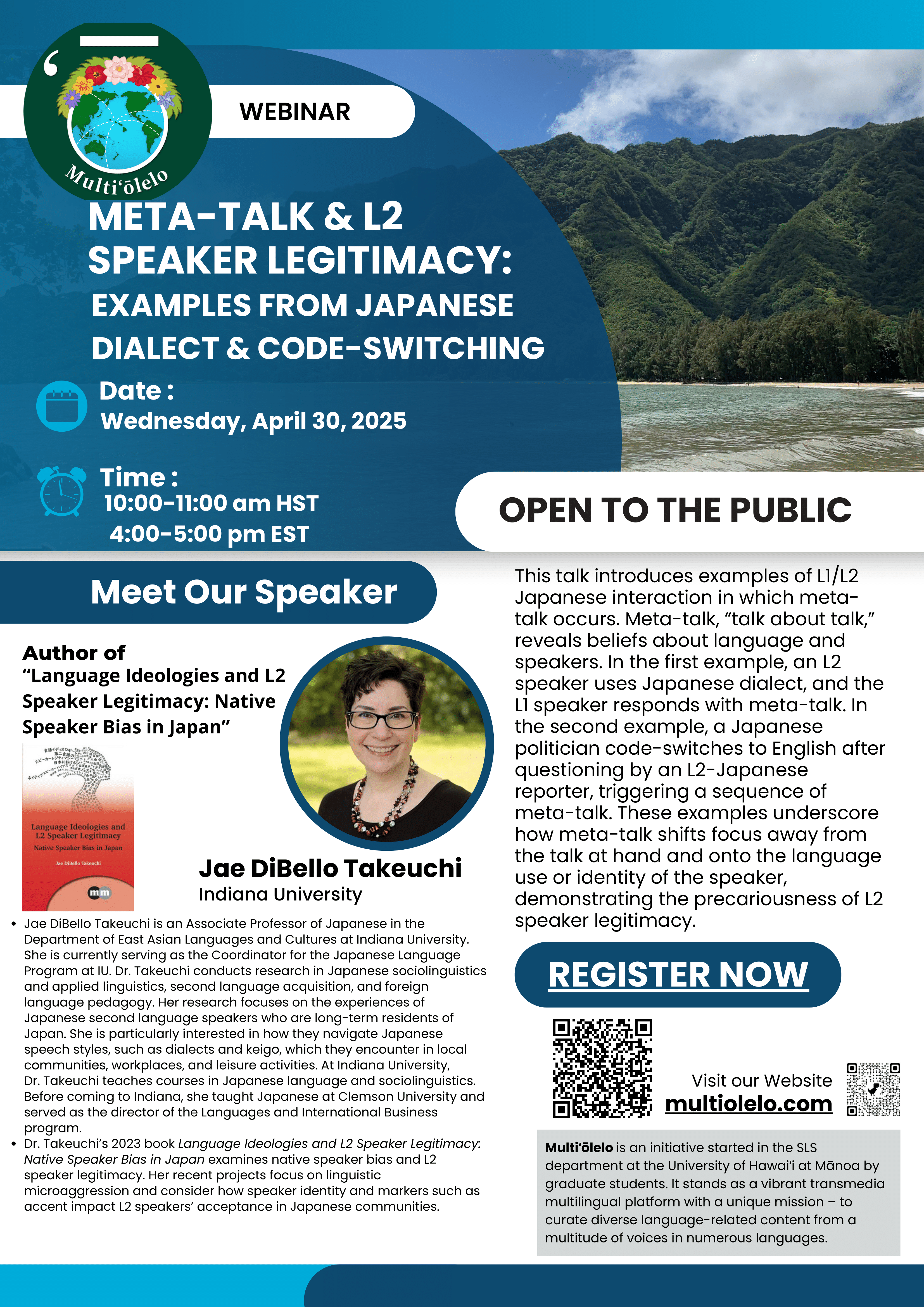
Meta-Talk & L2 Speaker Legitimacy: Examples from Japanese Dialect & Code-switching
Meta-talk (Takeuchi, 2020, 2024) refers to meta-linguistic commentary, or “talk about talk.” When interlocutors comment on linguistic form or choice of language instead of focusing on the talk at hand, they reveal beliefs about language and speakers. As such, meta-talk also makes language ideologies visible. In this presentation, I will share two examples of meta-talk in naturally occurring conversation between first and second language (L1 and L2) speakers of Japanese.
- The first example is an excerpt from a family dinner which includes L1 and L2 speakers of Japanese. The L2-Japanese speaker uses Japanese dialect during the interaction. The L1-Japanese speaker’s response, meta-talk about the L2 speaker’s dialect use, demonstrates how Japanese dialect can become a target for language ownership. Meta-talk also highlights the non-native status of the L2 speaker and suggests the question of who counts as a legitimate speaker of Japanese dialect.
- The second example comes from a press conference given in Japanese by a Japanese politician. The Japanese politician code-switches to English after being questioned (in Japanese) by an L2-Japanese reporter. Both the politician’s code-switching and the reporter’s response include meta-talk. Here, the meta-talk reveals interlocutors’ beliefs about language choice, and again calls into question L2 speaker legitimacy.
These two examples are each a single case study – one of Japanese dialect use and the other of Japanese-English code-switching. However, each demonstrates a core function of meta-talk, namely, to shift the focus away from the talk at hand and onto the language use or linguistic identity of the interlocutor. In the context of L1/L2 interaction, meta-talk demonstrates the precariousness of L2 speaker legitimacy.
Jae DiBello Takeuchi is an Associate Professor of Japanese in the Department of East Asian Languages and Cultures at Indiana University. She is currently serving as the Coordinator for the Japanese Language Program at IU. Dr. Takeuchi conducts research in Japanese sociolinguistics and applied linguistics, second language acquisition, and foreign language pedagogy. Her research focuses on the experiences of Japanese second language speakers who are long-term residents of Japan. She is particularly interested in how they navigate Japanese speech styles, such as dialects and keigo, which they encounter in local communities, workplaces, and leisure activities. At Indiana University, Dr. Takeuchi teaches courses in Japanese language and sociolinguistics. Before coming to Indiana, she taught Japanese at Clemson University and served as the director of the Languages and International Business program.Dr. Takeuchi’s 2023 book Language Ideologies and L2 Speaker Legitimacy: Native Speaker Bias in Japan examines native speaker bias and L2 speaker legitimacy. Her recent projects focus on linguistic microaggression and consider how speaker identity and markers such as accent impact L2 speakers’ acceptance in Japanese communities.
April 30, 2025
10 – 11 am, HST
 Multiʻōlelo