
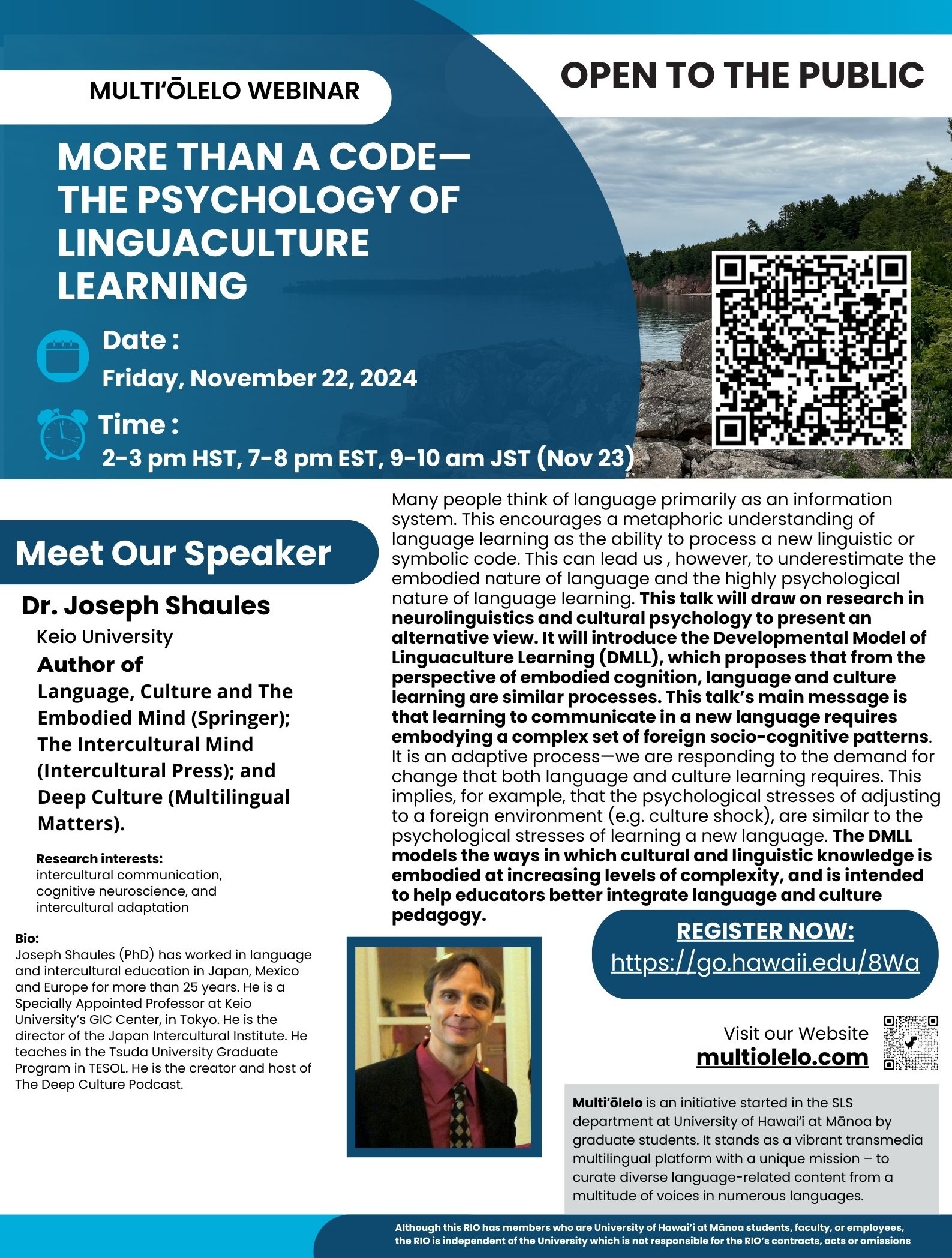
More than a code—the psychology of linguaculture learning
Many people think of language primarily as an information system. This encourages a metaphoric understanding of language learning as the ability to process a new linguistic or symbolic code. This can lead us, however, to underestimate the embodied nature of language and the highly psychological nature of language learning. This talk will draw on research in neurolinguistics and cultural psychology to present an alternative view. It will introduce the Developmental Model of Linguaculture Learning (DMLL), which proposes that from the perspective of embodied cognition, language and culture learning are similar processes. This talk’s main message is that learning to communicate in a new language requires embodying a complex set of foreign socio-cognitive patterns. It is an adaptive process—we are responding to the demand for change that both language and culture learning requires. This implies, for example, that the psychological stresses of adjusting to a foreign environment (e.g., culture shock) are similar to the psychological stresses of learning a new language. The DMLL models the ways in which cultural and linguistic knowledge is embodied at increasing levels of complexity and is intended to help educators better integrate language and culture pedagogy.
Dr. Joseph Shaules is a Specially Appointed Professor at Keio University’s GIC Center in Tokyo. He is also the director of the Japan Intercultural Institute and the creator and host of The Deep Culture Podcast. In addition, he teaches in the TESOL Graduate Program at Tsuda University. His research interests include intercultural communication, cognitive neuroscience, and intercultural adaptation. He has worked in language and intercultural education in Japan, Mexico, and Europe for more than 25 years. Books include Language, Culture, and The Embodied Mind (Springer); The Intercultural Mind (Intercultural Press); and Deep Culture (Multilingual Matters).
November 22, 2024
2 – 3 pm, HST
 Multiʻōlelo